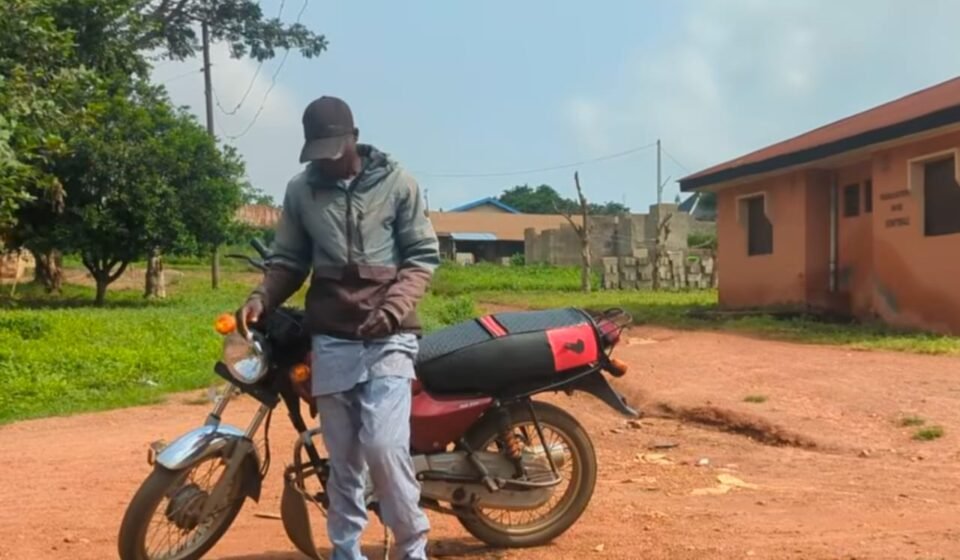

IRAGBIJI, Nigeria — Taiye Oladimeji lost his right leg in a road accident in 2011 and went back to work as a commercial motorcycle rider, known in Nigeria as an okada rider. The video above tells his story in his own words and shows how he works in Iragbiji, in Osun State.
“Even with my leg condition, I choose to work and hustle for myself so that I will not beg anybody for money on the street,” Oladimeji said.
He now says that work, which supports his family, is at risk. Oladimeji said he still owes ₦350,000 on his motorcycle and that riding it on one leg is “very difficult, painful, and risky.”
He said the accident happened on a Sunday in 2011 while he was working on the road. He spent five days at Ikirun hospital and was then referred to LAUTECH Teaching Hospital in Osogbo, where his leg was amputated.
Oladimeji calls himself “Oba Aro,” which he translates as “King of the Crippled,” a name he said he chose himself. “If anybody call me Oba Aro, I don’t feel offended at all, because I put the name on myself,” he said.
He bought his motorcycle through a hire-purchase arrangement for ₦1.5 million and has paid ₦1.15 million, about 77% of the price, he said. The owner who supplied it is pressing him to pay the rest. “If I don’t balance the 350,000 Naira, they will collect the okada back from me, and that will destroy my source of living,” Oladimeji said.
He wants a tricycle known as a Keke NAPEP, which he said would be easier and safer for a rider with a disability and would let him keep earning. The tricycles take their name from the National Poverty Eradication Programme, which Leadership newspaper reported was introduced in 2001 to create jobs and reduce poverty.
His situation reflects a wider challenge. About 35 million Nigerians live with disabilities, according to the 2024 State of Disability Inclusion Report as reported by TheCable, which also said only 23 of Nigeria’s 36 states have enacted disability laws of their own. Nigeria’s 2018 Discrimination Against Persons with Disabilities (Prohibition) Act sets a 5% employment quota, but Development and Cooperation reported in 2026 that enforcement remains weak. A study of begging in Kwara State found that physical disability is associated with longer periods of begging, while stable employment and access to services are associated with less reliance on it.
Oladimeji is appealing for help. “I am appealing to government, kind-hearted Nigerians, and organizations to please assist me to get a Keke NAPEP so that I can ride comfortably and feed my family,” he said.